
Complete pump out and scrubbing of kitchen grease interceptors with documented FOG disposal. The maintenance that keeps grease out of your drains and inspectors satisfied.
Grease trap cleaning, properly called interceptor maintenance, is the complete emptying of a kitchen's grease interceptor. The floating fat mat, the settled food solids and the water between them are all removed, the walls and baffles are scrubbed and descaled, and the unit is function checked on refill. An interceptor that is only skimmed keeps its solids and fails within days.
Every food establishment in Dubai needs this. Restaurants, cafeterias, hotel kitchens, cloud kitchens, bakeries, catering units and staff canteens, whether the trap is a small under sink unit or an in ground interceptor. Neglect follows a fixed sequence. The grease layer thickens past the baffle, fats, oils and grease, known as FOG, pass straight through into the drain line, set hard in the pipe, and the kitchen floor drain backs up during service. Then comes the odor, the pest interest, and the inspection finding. We service kitchens across Dubai from Al Quoz, from Deira and Bur Dubai restaurant rows to Business Bay and Marina hotel kitchens and the catering units of the industrial areas.
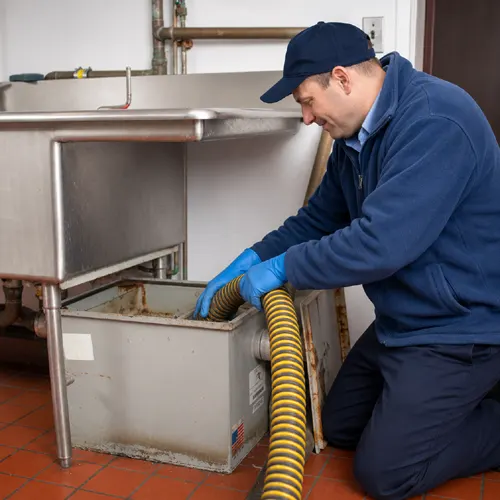
Trap Overflowing Before Service Tonight
If the interceptor is overflowing or the kitchen drain is backing up during prep, message us the trap type and your location on WhatsApp and we will slot the earliest crew available within working hours, Saturday to Thursday 7:30 to 18:30. Restaurant districts in Deira, Bur Dubai, Business Bay and Dubai Marina are on our regular routes, and an under sink unit takes roughly 30 to 60 minutes from lid to refill.
If the drain line beyond the trap has already coated up, cleaning the trap alone will not restore flow. The line itself needs high pressure jetting, and we routinely do both in one visit so the kitchen opens on time.
Our Grease Trap Cleaning Process
A proper interceptor service is a full reset, not a skim. Our crew works through the same sequence on every visit:
- Isolation and protection. Kitchen surfaces around the trap are covered, the trap is taken out of flow, and the lid is lifted carefully. Interceptors hold gas and splash risk that a kitchen does not need at prep time.
- Full pump out. A sealed vacuum line removes everything. The grease mat, the settled solids and the water column. Nothing is left to seed the next buildup.
- Scrape, scrub and descale. Walls, base, baffles and the underside of the lid are scraped, scrubbed and descaled back to the metal or plastic. Baffles are checked for damage and correct seating.
- Fitting inspection. Inlet and outlet connections are checked for bypass, leaks or collapse. An interceptor with a failed outlet fitting passes grease no matter how often it is cleaned.
- Refill and function check. The trap is refilled with clean water so separation starts working the moment we leave, and flow is verified through to the drain.
- Documented FOG disposal. Collected grease and solids leave in sealed containers for disposal at an approved facility, and you receive a dated service record for your compliance file.
Signs Your Grease Trap Needs Cleaning
The interceptor is telling you when the grease layer is visibly thick at the lid, the kitchen drains slow after service, odor rises from the floor gullies, or grease appears downstream where it should never reach. By the time a kitchen smells the trap, it has usually been passing FOG for weeks.
- Sinks and floor drains that gulp slowly during the dish rush
- A sour, fatty odor near the trap or the nearest gully, worst in the afternoon heat
- Visible grease in the outlet chamber or the next manhole downstream
- Fly and pest activity concentrated around the trap lid
- More than a month since the last documented service in a working kitchen
How Often Should a Grease Trap Be Cleaned in Dubai
Monthly cleaning is the safe baseline for most Dubai restaurants. High volume and heavy frying kitchens often need service every two weeks, while small cafés with light cooking may manage on six to eight week cycles. Under sink traps fill far faster than in ground interceptors because they hold a fraction of the volume.
A useful field rule. When the combined grease and solids layer occupies about a quarter of the interceptor's depth, separation efficiency collapses and the unit is due, regardless of the calendar. Dubai Municipality requires food establishments to maintain grease traps and keep evidence of it. Confirm your exact schedule obligations with your food safety officer, and keep our dated service records on file as that evidence. A well kept interceptor also protects everything downstream. Kitchens that service the trap on schedule call us far less often for septic tank cleaning, because the tank stops receiving the grease the interceptor was built to stop.
Large Kitchens and Smaller Setups
Large kitchens with in ground interceptors are scheduled operations. We service before opening or after close, coordinate with the kitchen manager, and handle interceptors that hold hundreds of litres with a tanker rather than drums. Multi outlet operators put all their sites on one contract calendar so no branch ever lapses.
Smaller setups, cafés, cloud kitchens and villa businesses with commercial grade cooking, usually run compact under sink traps that need more frequent but faster service. The trap is small enough that one missed month undoes the previous three, so we set these clients on fixed recurring visits with a reminder before each one. Either way the standard is identical. Full pump out, scrub, function check, documented disposal.
Why Hygiene Environmental Cleaning Services
Because we clean interceptors the way inspectors wish everyone did. Full evacuation rather than skimming, baffles scrubbed rather than rinsed, function verified on refill, and FOG disposed at approved facilities with paperwork you can produce on demand. Our crews have serviced Dubai kitchens for years and work around service hours as a matter of routine. Early mornings and post closing slots cost nothing extra to schedule.
We are blunt when it saves you money. If your interceptor is undersized for the kitchen's output, or an outlet fitting is bypassing, we tell you on the first visit instead of profiting from a unit that can never keep up. Fixed pricing, recurring schedules, and the same Al Quoz crew each time.
Frequently Asked Questions
How much does grease trap cleaning cost in Dubai?
Cost scales with interceptor size and condition. A compact under sink unit is a quick, inexpensive service, while a large in ground interceptor that has been neglected takes tanker capacity and considerably more labour. Recurring contract visits cost less per service than one off callouts because the unit never reaches a heavy state. Tell Hygiene Environmental Cleaning Services your trap type and roughly when it was last serviced, a photo on WhatsApp works, and we will send a fixed quote the same working day.
How often does Dubai Municipality require grease trap cleaning?
Dubai Municipality requires food establishments to maintain grease traps and keep evidence of regular servicing. The exact interval expected depends on your establishment type and interceptor size, so confirm your current schedule with your food safety officer. In practice, monthly service satisfies most kitchens and heavy frying operations need fortnightly visits. What inspectors consistently ask for is documentation, which is why every Hygiene service ends with a dated record of the cleaning and the FOG disposal for your compliance file.
Can you clean the trap without disrupting kitchen service?
Yes. The standard approach for working kitchens is servicing before opening or after close, and an under sink trap takes roughly 30 to 60 minutes from lid to refill. We isolate and protect the surrounding area, so prep surfaces are unaffected, and the trap is refilled with clean water and back in flow before the crew leaves. For multi site operators we build the whole route around your quietest hours, inside our Saturday to Thursday working week.
What happens to the grease you remove?
Everything we pump out, the grease mat, food solids and wastewater, leaves your kitchen in sealed containers or a sealed tanker and is disposed of at an approved facility, with the disposal noted on your service record. FOG must never be poured to a drain, a gully or general waste, and traceable disposal is part of what your compliance file demonstrates. If a provider cannot show you where the grease goes, that is the moment to change provider.
Why does my kitchen still smell after the trap was cleaned?
A persistent odor after a genuine full clean usually means the smell is not coming from the interceptor. The drain line downstream is coated with old grease, a floor gully has a dry or failed water seal, or the outlet fitting is letting waste bypass into the line. We check the fittings during every service and tell you which of these it is. Coated lines are cleared with high pressure jetting, which we can do in the same visit as the trap service.
Is my grease trap the right size for my kitchen?
If the interceptor reaches a heavy grease layer in under two weeks despite full cleanings, it is very likely undersized for the kitchen's output. A trap can only separate what it has the volume to hold. Signs include grease visible at the outlet within days of service and repeated line blockages downstream. We assess capacity against your cooking volume on the first visit and tell you plainly whether more frequent servicing solves it or the unit genuinely needs upsizing.
Where can I find professional grease trap cleaning near me?
Choose a provider that pumps the interceptor out completely rather than skimming, scrubs and descales the baffles, refills and function checks the unit, and gives you dated records of both the service and the FOG disposal. Those records are what your compliance file is built from. Availability around kitchen hours matters as much as price. Hygiene Environmental Cleaning Services runs scheduled grease trap rounds across Dubai from Al Quoz, servicing restaurants, hotel kitchens and catering units before opening or after close as standard.